Buy korrektur.eu ?
We are moving the project
korrektur.eu .
Are you interested in purchasing the domain
korrektur.eu ?
domain@kv-gmbh.de · 0541-91531010
Buy korrektur.eu ?
Can complexity be objectively measured?
Complexity can be objectively measured to some extent, especially in the context of information theory and algorithmic complexity. In information theory, complexity can be measured using metrics such as entropy and Kolmogorov complexity, which provide objective measures of the amount of information or computational resources required to describe a system. However, when it comes to measuring the complexity of real-world systems or phenomena, there is often a subjective element involved, as different observers may prioritize different aspects of complexity. Therefore, while certain aspects of complexity can be objectively measured, the overall assessment of complexity may still involve some degree of subjectivity. **
What is the complexity of Mergesort?
The time complexity of Mergesort is O(n log n) in the worst-case scenario, where n is the number of elements in the array. This complexity arises from the fact that Mergesort divides the array into halves recursively and then merges them back together in sorted order. The space complexity of Mergesort is O(n) due to the need for additional space to store the divided subarrays during the sorting process. Overall, Mergesort is an efficient sorting algorithm that performs well on large datasets. **

Similar search terms for Complexity
Top-Angebote
Products related to Complexity:
-
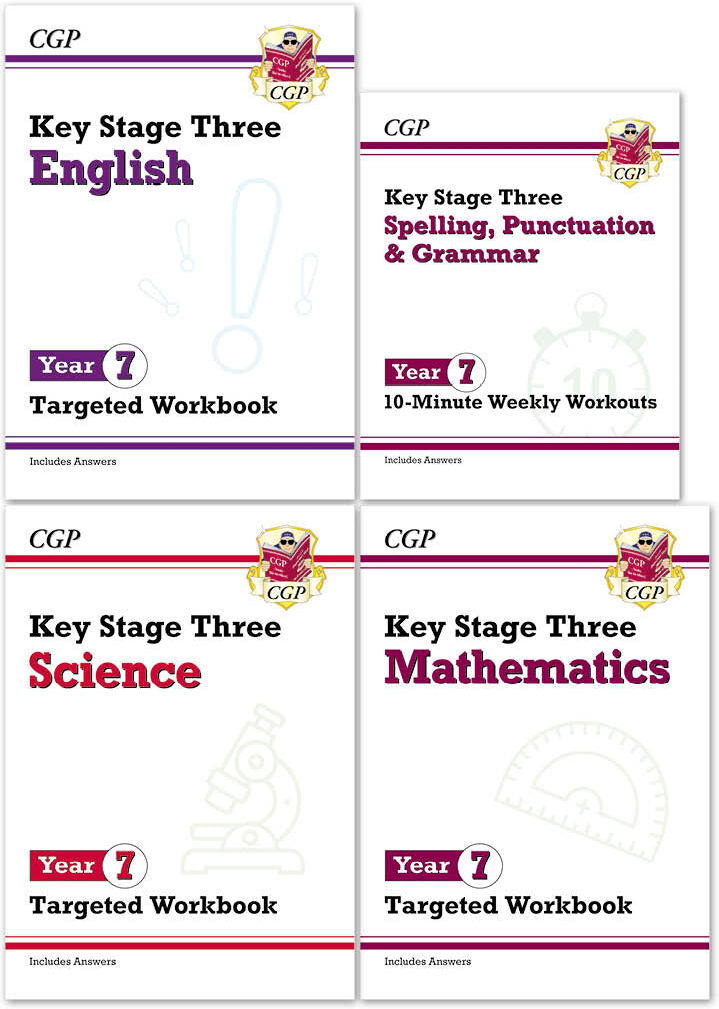
CGP Books CGP KS3 Year 7 Workbook Bundle – Ages 11-12 (Maths, English, Science, Spelling Punctuation and Grammar)You can't beat CGP books for KS3 practice! This brilliant bundle is exactly what Year 7 kids need to build their Maths, English and Science skills. It contains four books, full of essential practice — to be used in the classroom or at home! KS3 Year 7 Maths Targeted Workbook (9781789083163) KS3 Year 7 English Targeted Workbook (9781789087833) KS3 Year 7 Science Targeted Workbook (9781789082630) KS3 Year 7 Spelling, Punctuation and Grammar 10-Minute Weekly Workouts (9781837740550) KS3 Year 7 Maths Targeted Workbook For perfectly targeted Year 7 Maths practice, look no further. This KS3 Maths Yearly Targeted Workbook is loaded with practice questions - ideal for honing those essential Maths skills! It covers a range of topics and techniques from the KS3 syllabus, all set at the perfect difficulty for Year 7 pupils. For each topic, questions begin with a gentle warm-up, designed to get pupils up to speed and test what they already know, then progress to more difficult questions. KS3 Year 7 English Targeted Workbook For perfectly levelled Year 7 English practice, look no further! This KS3 English Yearly Targeted Workbook contains stacks of practice questions - ideal for honing those essential reading and writing skills, all matched to the National Curriculum. This brilliant workbook covers a huge variety of texts, from non-fiction to poetry, and helps students understand Shakespeare as well as develop vital essay writing skills. We’ve included prior knowledge checks for each topic, plus there’s extension activities enabling students to practise and integrate different skills that they’ve learned. Each topic is rounded off with a review section including test-style questions to bring everything together. KS3 Year 7 Science Targeted Workbook This beautifully crafted CGP Workbook features an array of Biology, Chemistry and Physics questions, all set at the perfect difficulty for students in Year 7. It's absolutely spot on for honing those all-important Science skills. The questions cover a range of techniques and topics, and aim to challenge common misunderstandings, prepare students for the mathsy and practical sections of the course, and help put what they've learned into context. Topics also include a selection of warm-up questions - to test what students already know about each topic. We've rounded the book off with a stack of mixed test-style questions to bring everything students have learned together in one place. KS3 Year 7 Spelling, Punctuation and Grammar 10-Minute Weekly Workouts This fantastic Weekly Workouts book is packed with targeted practice covering all the essential KS3 Spelling, Punctuation and Grammar skills - perfect for Year 7 students! Each workout consists of a selection of warm-up questions, followed by more challenging questions and problem-solving activities to really test students' SPaG knowledge. Plus, with one workout for every week of the school year, they're the perfect way to help students sharpen their skills and...27,99 £*Shipping: 2,99 £Secure redirect to the provider
-
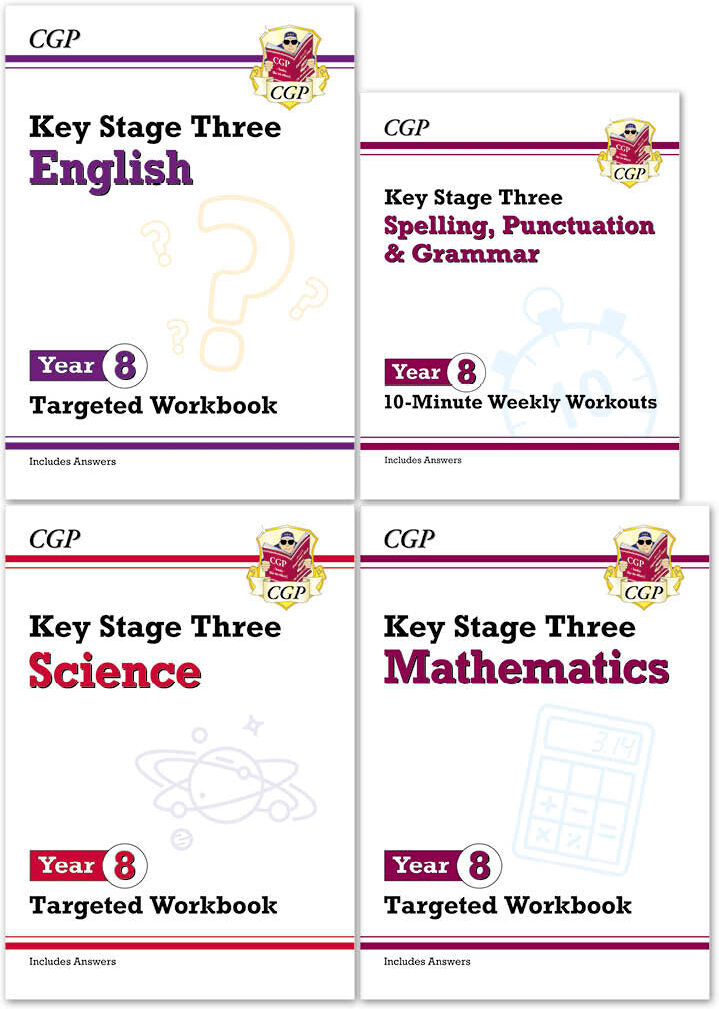
CGP Books CGP KS3 Year 8 Workbook Bundle – Ages 12-13 (Maths, English, Science, Spelling Punctuation and Grammar)You can't beat CGP books for KS3 practice! This brilliant bundle is exactly what Year 8 kids need to build their Maths, English and Science skills. It contains four books, full of essential practice — to be used in the classroom or at home! KS3 Year 8 Maths Targeted Workbook (9781789083170) KS3 Year 8 English Targeted Workbook (9781789087840) KS3 Year 8 Science Targeted Workbook (9781789082647) KS3 Year 8 Spelling, Punctuation and Grammar 10-Minute Weekly Workouts (9781837740567) KS3 Year 8 Maths Targeted Workbook If you're after Year 8 Maths practice, look no further. This KS3 Maths Yearly Targeted Workbook is loaded with practice questions - ideal for honing those essential Maths skills! It covers a range of topics and techniques from the KS3 syllabus, all set at the perfect difficulty for Year 8 pupils. For each topic, questions begin with a gentle warm-up, designed to get pupils up to speed and test what they already know, then progress to more difficult questions. KS3 Year 8 English Targeted Workbook For perfectly levelled Year 8 English practice, look no further! This KS3 English Yearly Targeted Workbook contains stacks of practice questions - ideal for honing those essential reading and writing skills, all matched to the National Curriculum. This brilliant workbook covers a huge variety of texts, from non-fiction to poetry, and helps students understand Shakespeare as well as develop vital essay writing skills. We’ve included prior knowledge checks for each topic, plus there’s extension activities enabling students to practise and integrate different skills that they’ve learned. Each topic is rounded off with a review section including test-style questions to bring everything together. KS3 Year 8 Science Targeted Workbook This spectacular CGP Workbook features an array of Biology, Chemistry and Physics questions, all set at the perfect difficulty for students in Year 8. It's absolutely spot on for honing those all-important Science skills. The questions cover a range of techniques and topics, and aim to challenge common misunderstandings, prepare students for the mathsy and practical sections of the course, and help put what they've learned into context. Topics also include a selection of warm-up questions - to test what students already know about each topic. KS3 Year 8 Spelling, Punctuation and Grammar 10-Minute Weekly Workouts This fantastic Weekly Workouts book is packed with targeted practice covering all the essential KS3 Spelling, Punctuation and Grammar skills - perfect for Year 8 students! Each workout consists of a selection of warm-up questions, followed by more challenging questions and problem-solving activities to really test students' SPaG knowledge. Plus, with one workout for every week of the school year, they're the perfect way to help students sharpen their skills and remember what they've learnt. All the answers are included at the back of the book, alongside a handy score sheet to keep track of students' progress -...27,99 £*Shipping: 2,99 £Secure redirect to the provider
-
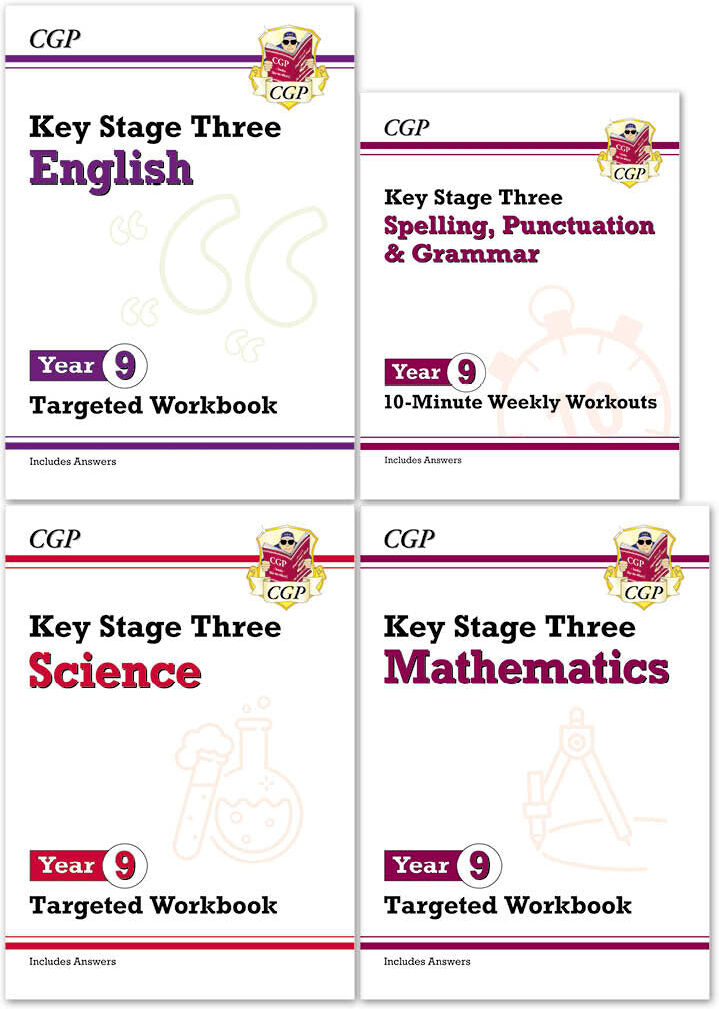
CGP Books CGP KS3 Year 9 Workbook Bundle – Ages 13-14 (Maths, English, Science, Spelling Punctuation and Grammar)You can't beat CGP books for KS3 practice! This brilliant bundle is exactly what Year 9 kids need to build their Maths, English and Science skills. It contains four books, full of essential practice — to be used in the classroom or at home! KS3 Year 9 Maths Targeted Workbook (9781789083187) KS3 Year 9 English Targeted Workbook (9781789087857) KS3 Year 9 Science Targeted Workbook (9781789082654) KS3 Year 9 Spelling, Punctuation and Grammar 10-Minute Weekly Workouts (9781837740574) KS3 Year 9 Maths Targeted Workbook If you're after Year 9 Maths practice, look no further. This KS3 Maths Yearly Targeted Workbook is loaded with practice questions - ideal for honing those essential Maths skills! It covers a range of topics and techniques from the KS3 syllabus, all set at the perfect difficulty for Year 9 pupils. For each topic, questions begin with a gentle warm-up, designed to get pupils up to speed and test what they already know, then progress to more difficult questions. KS3 Year 9 English Targeted Workbook For perfectly levelled Year 9 English practice, look no further! This KS3 English Yearly Targeted Workbook contains stacks of practice questions to hone those essential reading and writing skills - ideal for bridging the gap to GCSE. This brilliant workbook covers a huge variety of texts, from non-fiction to poetry, and helps students understand Shakespeare as well as develop vital essay writing skills. We’ve included prior knowledge checks for each topic, plus there’s extension activities enabling students to practise and integrate different skills that they’ve learned. Each topic is rounded off with a review section including test-style questions to bring everything together. KS3 Year 9 Science Targeted Workbook This wondrous CGP Workbook features an array of Biology, Chemistry and Physics questions, all set at the perfect difficulty for students in Year 9. It's absolutely spot on for honing those all-important Science skills. The questions cover a range of techniques and topics, and aim to challenge common misunderstandings, prepare students for the mathsy and practical sections of the course, and to help bridge the gap to GCSE. Topics also include a selection of warm-up questions - to test what students already know about each topic. We've rounded the book off with a stack of mixed test-style questions to bring everything students have learned together in one place. KS3 Year 9 Spelling, Punctuation and Grammar 10-Minute Weekly Workouts This fantastic Weekly Workouts book is packed with targeted practice covering all the essential KS3 Spelling, Punctuation and Grammar skills - perfect for Year 9 students! Each workout consists of a selection of warm-up questions, followed by more challenging questions and problem-solving activities to really test students' SPaG knowledge. Plus, with one workout for every week of the school year, they're the perfect way to help students sharpen their skills and remember what they've learnt. All the answers are...26,99 £*Shipping: 2,99 £Secure redirect to the provider
-
DESIGN ART "Designart ""Gold Purple Transcending Complexity II"" Abstract Curtain - Blackout Abstract Curtain - 1 Panel""Bring a breath of fresh air to your windows and spruce up any space in your home with this ""Gold Purple Transcending Complexity II"" Abstract 1 panel curtain. This beautiful Modern & Contemporary curtain is handmade on demand just for you."83,36 $*Shipping: 0,00 $Secure redirect to the provider

-
How can one get rid of complexity?
One can get rid of complexity by breaking down the problem or situation into smaller, more manageable parts. This can help to identify the root causes of the complexity and address them individually. Additionally, simplifying processes, communication, and decision-making can help reduce complexity. It is also important to prioritize and focus on the most important aspects, while letting go of unnecessary details. Finally, seeking input and collaboration from others can provide fresh perspectives and help to streamline complex situations. **
-
What is the complexity of composing two functions?
Composing two functions has a complexity of O(1), as it involves simply applying one function to the output of the other. The time complexity does not depend on the size of the input, as the functions are applied sequentially. Therefore, the complexity of composing two functions is constant and does not increase with the size of the input. **
-
What are the Big O notations for time complexity?
The Big O notations for time complexity are used to describe the upper bound on the growth rate of an algorithm's running time as the input size increases. Some common Big O notations include O(1) for constant time complexity, O(log n) for logarithmic time complexity, O(n) for linear time complexity, O(n^2) for quadratic time complexity, and O(2^n) for exponential time complexity. These notations help in analyzing and comparing the efficiency of different algorithms. **
-
How do you determine the complexity of a function?
The complexity of a function can be determined by analyzing its time and space requirements. This can be done by examining the number of operations the function performs and the amount of memory it uses. Additionally, the complexity can be influenced by the size of the input data and the efficiency of the algorithm used in the function. By considering these factors, one can determine the complexity of a function, which is often expressed using Big O notation. **


What are the Landau symbols for the time complexity?
The Landau symbols for time complexity are commonly used to describe the upper and lower bounds of an algorithm's running time. The most commonly used Landau symbols for time complexity are O (big O) for upper bound, Ω (big omega) for lower bound, and Θ (big theta) for both upper and lower bounds. These symbols are used to express the growth rate of an algorithm's running time in terms of the input size. For example, if an algorithm has a time complexity of O(n^2), it means that the running time of the algorithm grows no faster than n^2 as the input size increases. **
What is the complexity of semiconductor technology or microsystems technology?
The complexity of semiconductor technology or microsystems technology is high due to the intricate processes involved in designing, manufacturing, and integrating tiny electronic components. These technologies require precise control at the nanoscale level, involving complex materials, intricate fabrication techniques, and sophisticated equipment. Additionally, the rapid pace of innovation and the need for continuous improvement in performance and miniaturization add to the complexity of these technologies. As a result, semiconductor and microsystems technology require significant expertise, resources, and investment to develop and produce advanced electronic devices. **
Top-Angebote
Products related to Complexity:
-
DESIGN ART "Designart ""Gold Purple Transcending Complexity II"" Abstract Curtain - Blackout Abstract Curtain - 1 Panel""Bring a breath of fresh air to your windows and spruce up any space in your home with this ""Gold Purple Transcending Complexity II"" Abstract 1 panel curtain. This beautiful Modern & Contemporary curtain is handmade on demand just for you."72,42 $*Shipping: 0,00 $Secure redirect to the provider
-
DK Help Your Kids with English Ages 10–16 – KS3 & KS4 Grammar, Writing & Revision GuideIf English is sounding like a foreign language, make it easy and effortless with the ultimate study guide. This visual reference book takes you through all the different parts of the English language, leaving you ready to help your children tackle the trickiest of subjects. Carol Vorderman's unique study aid encourages parents and children to work together as a team to understand and use all aspects of the English language, including grammar, punctuation, and spelling.This latest title in the best-selling Help Your Kids series combines pictures, diagrams, instructions, and examples to cover the components of the school syllabus, while building knowledge, boosting confidence, and aiding understanding. With your support, children can overcome the challenges of English, leaving them calm, confident, and exam ready.9,99 £*Shipping: 2,99 £Secure redirect to the provider
-
CGP Books CGP KS3 Year 7 Workbook Bundle – Ages 11-12 (Maths, English, Science, Spelling Punctuation and Grammar)You can't beat CGP books for KS3 practice! This brilliant bundle is exactly what Year 7 kids need to build their Maths, English and Science skills. It contains four books, full of essential practice — to be used in the classroom or at home! KS3 Year 7 Maths Targeted Workbook (9781789083163) KS3 Year 7 English Targeted Workbook (9781789087833) KS3 Year 7 Science Targeted Workbook (9781789082630) KS3 Year 7 Spelling, Punctuation and Grammar 10-Minute Weekly Workouts (9781837740550) KS3 Year 7 Maths Targeted Workbook For perfectly targeted Year 7 Maths practice, look no further. This KS3 Maths Yearly Targeted Workbook is loaded with practice questions - ideal for honing those essential Maths skills! It covers a range of topics and techniques from the KS3 syllabus, all set at the perfect difficulty for Year 7 pupils. For each topic, questions begin with a gentle warm-up, designed to get pupils up to speed and test what they already know, then progress to more difficult questions. KS3 Year 7 English Targeted Workbook For perfectly levelled Year 7 English practice, look no further! This KS3 English Yearly Targeted Workbook contains stacks of practice questions - ideal for honing those essential reading and writing skills, all matched to the National Curriculum. This brilliant workbook covers a huge variety of texts, from non-fiction to poetry, and helps students understand Shakespeare as well as develop vital essay writing skills. We’ve included prior knowledge checks for each topic, plus there’s extension activities enabling students to practise and integrate different skills that they’ve learned. Each topic is rounded off with a review section including test-style questions to bring everything together. KS3 Year 7 Science Targeted Workbook This beautifully crafted CGP Workbook features an array of Biology, Chemistry and Physics questions, all set at the perfect difficulty for students in Year 7. It's absolutely spot on for honing those all-important Science skills. The questions cover a range of techniques and topics, and aim to challenge common misunderstandings, prepare students for the mathsy and practical sections of the course, and help put what they've learned into context. Topics also include a selection of warm-up questions - to test what students already know about each topic. We've rounded the book off with a stack of mixed test-style questions to bring everything students have learned together in one place. KS3 Year 7 Spelling, Punctuation and Grammar 10-Minute Weekly Workouts This fantastic Weekly Workouts book is packed with targeted practice covering all the essential KS3 Spelling, Punctuation and Grammar skills - perfect for Year 7 students! Each workout consists of a selection of warm-up questions, followed by more challenging questions and problem-solving activities to really test students' SPaG knowledge. Plus, with one workout for every week of the school year, they're the perfect way to help students sharpen their skills and...27,99 £*Shipping: 2,99 £Secure redirect to the provider
-
CGP Books CGP KS3 Year 8 Workbook Bundle – Ages 12-13 (Maths, English, Science, Spelling Punctuation and Grammar)You can't beat CGP books for KS3 practice! This brilliant bundle is exactly what Year 8 kids need to build their Maths, English and Science skills. It contains four books, full of essential practice — to be used in the classroom or at home! KS3 Year 8 Maths Targeted Workbook (9781789083170) KS3 Year 8 English Targeted Workbook (9781789087840) KS3 Year 8 Science Targeted Workbook (9781789082647) KS3 Year 8 Spelling, Punctuation and Grammar 10-Minute Weekly Workouts (9781837740567) KS3 Year 8 Maths Targeted Workbook If you're after Year 8 Maths practice, look no further. This KS3 Maths Yearly Targeted Workbook is loaded with practice questions - ideal for honing those essential Maths skills! It covers a range of topics and techniques from the KS3 syllabus, all set at the perfect difficulty for Year 8 pupils. For each topic, questions begin with a gentle warm-up, designed to get pupils up to speed and test what they already know, then progress to more difficult questions. KS3 Year 8 English Targeted Workbook For perfectly levelled Year 8 English practice, look no further! This KS3 English Yearly Targeted Workbook contains stacks of practice questions - ideal for honing those essential reading and writing skills, all matched to the National Curriculum. This brilliant workbook covers a huge variety of texts, from non-fiction to poetry, and helps students understand Shakespeare as well as develop vital essay writing skills. We’ve included prior knowledge checks for each topic, plus there’s extension activities enabling students to practise and integrate different skills that they’ve learned. Each topic is rounded off with a review section including test-style questions to bring everything together. KS3 Year 8 Science Targeted Workbook This spectacular CGP Workbook features an array of Biology, Chemistry and Physics questions, all set at the perfect difficulty for students in Year 8. It's absolutely spot on for honing those all-important Science skills. The questions cover a range of techniques and topics, and aim to challenge common misunderstandings, prepare students for the mathsy and practical sections of the course, and help put what they've learned into context. Topics also include a selection of warm-up questions - to test what students already know about each topic. KS3 Year 8 Spelling, Punctuation and Grammar 10-Minute Weekly Workouts This fantastic Weekly Workouts book is packed with targeted practice covering all the essential KS3 Spelling, Punctuation and Grammar skills - perfect for Year 8 students! Each workout consists of a selection of warm-up questions, followed by more challenging questions and problem-solving activities to really test students' SPaG knowledge. Plus, with one workout for every week of the school year, they're the perfect way to help students sharpen their skills and remember what they've learnt. All the answers are included at the back of the book, alongside a handy score sheet to keep track of students' progress -...27,99 £*Shipping: 2,99 £Secure redirect to the provider
-
Can complexity be objectively measured?
Complexity can be objectively measured to some extent, especially in the context of information theory and algorithmic complexity. In information theory, complexity can be measured using metrics such as entropy and Kolmogorov complexity, which provide objective measures of the amount of information or computational resources required to describe a system. However, when it comes to measuring the complexity of real-world systems or phenomena, there is often a subjective element involved, as different observers may prioritize different aspects of complexity. Therefore, while certain aspects of complexity can be objectively measured, the overall assessment of complexity may still involve some degree of subjectivity. **
-
What is the complexity of Mergesort?
The time complexity of Mergesort is O(n log n) in the worst-case scenario, where n is the number of elements in the array. This complexity arises from the fact that Mergesort divides the array into halves recursively and then merges them back together in sorted order. The space complexity of Mergesort is O(n) due to the need for additional space to store the divided subarrays during the sorting process. Overall, Mergesort is an efficient sorting algorithm that performs well on large datasets. **
-
How can one get rid of complexity?
One can get rid of complexity by breaking down the problem or situation into smaller, more manageable parts. This can help to identify the root causes of the complexity and address them individually. Additionally, simplifying processes, communication, and decision-making can help reduce complexity. It is also important to prioritize and focus on the most important aspects, while letting go of unnecessary details. Finally, seeking input and collaboration from others can provide fresh perspectives and help to streamline complex situations. **
-
What is the complexity of composing two functions?
Composing two functions has a complexity of O(1), as it involves simply applying one function to the output of the other. The time complexity does not depend on the size of the input, as the functions are applied sequentially. Therefore, the complexity of composing two functions is constant and does not increase with the size of the input. **
Similar search terms for Complexity
-
CGP Books CGP KS3 Year 9 Workbook Bundle – Ages 13-14 (Maths, English, Science, Spelling Punctuation and Grammar)You can't beat CGP books for KS3 practice! This brilliant bundle is exactly what Year 9 kids need to build their Maths, English and Science skills. It contains four books, full of essential practice — to be used in the classroom or at home! KS3 Year 9 Maths Targeted Workbook (9781789083187) KS3 Year 9 English Targeted Workbook (9781789087857) KS3 Year 9 Science Targeted Workbook (9781789082654) KS3 Year 9 Spelling, Punctuation and Grammar 10-Minute Weekly Workouts (9781837740574) KS3 Year 9 Maths Targeted Workbook If you're after Year 9 Maths practice, look no further. This KS3 Maths Yearly Targeted Workbook is loaded with practice questions - ideal for honing those essential Maths skills! It covers a range of topics and techniques from the KS3 syllabus, all set at the perfect difficulty for Year 9 pupils. For each topic, questions begin with a gentle warm-up, designed to get pupils up to speed and test what they already know, then progress to more difficult questions. KS3 Year 9 English Targeted Workbook For perfectly levelled Year 9 English practice, look no further! This KS3 English Yearly Targeted Workbook contains stacks of practice questions to hone those essential reading and writing skills - ideal for bridging the gap to GCSE. This brilliant workbook covers a huge variety of texts, from non-fiction to poetry, and helps students understand Shakespeare as well as develop vital essay writing skills. We’ve included prior knowledge checks for each topic, plus there’s extension activities enabling students to practise and integrate different skills that they’ve learned. Each topic is rounded off with a review section including test-style questions to bring everything together. KS3 Year 9 Science Targeted Workbook This wondrous CGP Workbook features an array of Biology, Chemistry and Physics questions, all set at the perfect difficulty for students in Year 9. It's absolutely spot on for honing those all-important Science skills. The questions cover a range of techniques and topics, and aim to challenge common misunderstandings, prepare students for the mathsy and practical sections of the course, and to help bridge the gap to GCSE. Topics also include a selection of warm-up questions - to test what students already know about each topic. We've rounded the book off with a stack of mixed test-style questions to bring everything students have learned together in one place. KS3 Year 9 Spelling, Punctuation and Grammar 10-Minute Weekly Workouts This fantastic Weekly Workouts book is packed with targeted practice covering all the essential KS3 Spelling, Punctuation and Grammar skills - perfect for Year 9 students! Each workout consists of a selection of warm-up questions, followed by more challenging questions and problem-solving activities to really test students' SPaG knowledge. Plus, with one workout for every week of the school year, they're the perfect way to help students sharpen their skills and remember what they've learnt. All the answers are...26,99 £*Shipping: 2,99 £Secure redirect to the provider
-
DESIGN ART "Designart ""Gold Purple Transcending Complexity II"" Abstract Curtain - Blackout Abstract Curtain - 1 Panel""Bring a breath of fresh air to your windows and spruce up any space in your home with this ""Gold Purple Transcending Complexity II"" Abstract 1 panel curtain. This beautiful Modern & Contemporary curtain is handmade on demand just for you."83,36 $*Shipping: 0,00 $Secure redirect to the provider
-
DESIGN ART "Designart ""Gold Purple Transcending Complexity II"" Abstract Curtain - Blackout Abstract Curtain - 1 Panel""Bring a breath of fresh air to your windows and spruce up any space in your home with this ""Gold Purple Transcending Complexity II"" Abstract 1 panel curtain. This beautiful Modern & Contemporary curtain is handmade on demand just for you."88,65 $*Shipping: 0,00 $Secure redirect to the provider
-
DESIGN ART "Designart ""Gold Purple Transcending Complexity II"" Abstract Curtain - Blackout Abstract Curtain - 1 Panel""Bring a breath of fresh air to your windows and spruce up any space in your home with this ""Gold Purple Transcending Complexity II"" Abstract 1 panel curtain. This beautiful Modern & Contemporary curtain is handmade on demand just for you."90,87 $*Shipping: 0,00 $Secure redirect to the provider
-
What are the Big O notations for time complexity?
The Big O notations for time complexity are used to describe the upper bound on the growth rate of an algorithm's running time as the input size increases. Some common Big O notations include O(1) for constant time complexity, O(log n) for logarithmic time complexity, O(n) for linear time complexity, O(n^2) for quadratic time complexity, and O(2^n) for exponential time complexity. These notations help in analyzing and comparing the efficiency of different algorithms. **
-
How do you determine the complexity of a function?
The complexity of a function can be determined by analyzing its time and space requirements. This can be done by examining the number of operations the function performs and the amount of memory it uses. Additionally, the complexity can be influenced by the size of the input data and the efficiency of the algorithm used in the function. By considering these factors, one can determine the complexity of a function, which is often expressed using Big O notation. **
-
What are the Landau symbols for the time complexity?
The Landau symbols for time complexity are commonly used to describe the upper and lower bounds of an algorithm's running time. The most commonly used Landau symbols for time complexity are O (big O) for upper bound, Ω (big omega) for lower bound, and Θ (big theta) for both upper and lower bounds. These symbols are used to express the growth rate of an algorithm's running time in terms of the input size. For example, if an algorithm has a time complexity of O(n^2), it means that the running time of the algorithm grows no faster than n^2 as the input size increases. **
-
What is the complexity of semiconductor technology or microsystems technology?
The complexity of semiconductor technology or microsystems technology is high due to the intricate processes involved in designing, manufacturing, and integrating tiny electronic components. These technologies require precise control at the nanoscale level, involving complex materials, intricate fabrication techniques, and sophisticated equipment. Additionally, the rapid pace of innovation and the need for continuous improvement in performance and miniaturization add to the complexity of these technologies. As a result, semiconductor and microsystems technology require significant expertise, resources, and investment to develop and produce advanced electronic devices. **
* All prices are inclusive of VAT and, if applicable, plus shipping costs. The offer information is based on the details provided by the respective shop and is updated through automated processes. Real-time updates do not occur, so deviations can occur in individual cases. ** Note: Parts of this content were created by AI.