Buy korrektur.eu ?
We are moving the project
korrektur.eu .
Are you interested in purchasing the domain
korrektur.eu ?
domain@kv-gmbh.de · 0541-91531010
Buy korrektur.eu ?
Does disinfectant kill fungi?
Yes, disinfectants can kill fungi. Fungi are susceptible to a variety of disinfectants, including bleach, hydrogen peroxide, and quaternary ammonium compounds. It is important to use the appropriate disinfectant and follow the manufacturer's instructions to effectively kill fungi and prevent their growth. **
Are these mold fungi?
Without being able to see the specific fungi in question, it is difficult to definitively say whether they are mold fungi. However, mold fungi typically appear as fuzzy or powdery growths that are often green, black, or white in color. They thrive in damp, warm environments and can be found on a variety of surfaces. If you suspect that the fungi you are seeing are mold, it is best to have them professionally inspected and tested to determine the exact type of fungi present. **


Similar search terms for Fungi
Top-Angebote
Products related to Fungi:
-
Markslöjd Fungi rechargeable table lamp for outdoor use, black Fungi, dimmable, Black, metal, ModernRechargeable and portable table lamp that can be easily transported from room to room and used outdoors. The lamp is battery-operated and can be used wirelessly for up to 8 hours. Mushroom-shaped and minimalist design made of metal. IP44 protection rating and suitable for temporary outdoor use. Touch dimmer and switch on the top of the shade.75,90 £*Shipping: 4,99 £Secure redirect to the provider
-
Pegasus Press Fungi - Tactical Two-Player Card Game - 113 Cards - MulticolourA tactical two-player card game about gathering, trading, and preparing mushrooms. Players compete to build the most valuable collection while managing the changing woodland and market opportunities. Suitable for ages 10+ and designed for two players.11,16 £*Shipping: 3,95 £Secure redirect to the provider
-
DK Help Your Kids with English Ages 10–16 – KS3 & KS4 Grammar, Writing & Revision GuideIf English is sounding like a foreign language, make it easy and effortless with the ultimate study guide. This visual reference book takes you through all the different parts of the English language, leaving you ready to help your children tackle the trickiest of subjects. Carol Vorderman's unique study aid encourages parents and children to work together as a team to understand and use all aspects of the English language, including grammar, punctuation, and spelling.This latest title in the best-selling Help Your Kids series combines pictures, diagrams, instructions, and examples to cover the components of the school syllabus, while building knowledge, boosting confidence, and aiding understanding. With your support, children can overcome the challenges of English, leaving them calm, confident, and exam ready.9,99 £*Shipping: 2,99 £Secure redirect to the provider



-
Does ethanol kill fungi?
Yes, ethanol is effective at killing fungi. Ethanol disrupts the cell membrane of fungi, leading to their death. It is commonly used as a disinfectant and antiseptic to kill a wide range of microorganisms, including fungi. Ethanol is often used in healthcare settings and in household cleaning products to eliminate fungal growth on surfaces. **
-
How contagious are fungi?
Fungi can be contagious to varying degrees depending on the specific type of fungus and the individual's immune system. Some fungi, such as those that cause athlete's foot or ringworm, are highly contagious and can easily spread through direct contact with an infected person or contaminated surfaces. Other fungi, such as those that cause fungal pneumonia or systemic fungal infections, are less contagious and typically require more intimate or prolonged contact to spread. It's important to practice good hygiene and take precautions to prevent the spread of fungal infections. **
-
Does my plant have fungi?
To determine if your plant has fungi, look for signs such as discolored or wilting leaves, moldy growth on the soil or plant, or a musty smell. You may also notice fuzzy white or black spots on the plant's leaves or stems. If you suspect fungi, it's best to remove the affected parts of the plant and improve air circulation to prevent further spread. Additionally, you can consult a plant expert or take a sample to a local nursery for identification and treatment recommendations. **
-
How do fungi feed themselves?
Fungi feed themselves by absorbing nutrients from their surroundings. They secrete enzymes that break down organic matter into simpler compounds, which they then absorb through their cell walls. Fungi can obtain nutrients from a variety of sources, including decaying organic material, living organisms, and even inorganic substances. This ability to break down and absorb nutrients from diverse sources is one of the reasons fungi are such successful and widespread organisms in nature. **
Why do fungi form fruiting bodies?
Fungi form fruiting bodies as a means of reproduction. These structures contain spores, which are dispersed into the environment to colonize new areas and start new fungal colonies. Fruiting bodies also help fungi to attract insects or animals that can aid in spore dispersal. Additionally, the formation of fruiting bodies allows fungi to conserve energy and resources until conditions are optimal for spore dispersal and germination. **
What is the metabolism of fungi?
The metabolism of fungi is primarily heterotrophic, meaning they obtain their energy and nutrients from organic sources. Fungi secrete enzymes to break down complex organic molecules into simpler compounds, which they can then absorb and use for energy and growth. Some fungi are also capable of mutualistic relationships with other organisms, such as mycorrhizal fungi that form symbiotic associations with plant roots to exchange nutrients. Overall, the metabolism of fungi is diverse and adaptable, allowing them to thrive in a wide range of environments. **
Top-Angebote
Products related to Fungi:
-
Graham & Brown Fungi Folklore WallpaperBring the enchanting world of the forest into your home with our Fungi Folklore Willow Wallpaper. The delicate white linework on a calming sage green backdrop brings a touch of whimsical beauty and nature-inspired elegance.200,00 $*Shipping: 0,00 $Secure redirect to the provider
-
Eladiet Inmuni Fungi 60 CapsulesNutrition and Supplements Algae, Mushrooms and Medicinal Fungi Eladiet Inmuni Fungi 60 Capsules A food supplement based on a combination of four different fungi, rich in polysaccharides and vitamin C, which contributes to the normal functioning of the immune system.18,03 £*Shipping: 3,99 £Secure redirect to the provider
-
Markslöjd Fungi rechargeable table lamp for outdoor use, black Fungi, dimmable, Black, metal, ModernRechargeable and portable table lamp that can be easily transported from room to room and used outdoors. The lamp is battery-operated and can be used wirelessly for up to 8 hours. Mushroom-shaped and minimalist design made of metal. IP44 protection rating and suitable for temporary outdoor use. Touch dimmer and switch on the top of the shade.75,90 £*Shipping: 4,99 £Secure redirect to the provider
-
Does disinfectant kill fungi?
Yes, disinfectants can kill fungi. Fungi are susceptible to a variety of disinfectants, including bleach, hydrogen peroxide, and quaternary ammonium compounds. It is important to use the appropriate disinfectant and follow the manufacturer's instructions to effectively kill fungi and prevent their growth. **
-
Are these mold fungi?
Without being able to see the specific fungi in question, it is difficult to definitively say whether they are mold fungi. However, mold fungi typically appear as fuzzy or powdery growths that are often green, black, or white in color. They thrive in damp, warm environments and can be found on a variety of surfaces. If you suspect that the fungi you are seeing are mold, it is best to have them professionally inspected and tested to determine the exact type of fungi present. **
-
Does ethanol kill fungi?
Yes, ethanol is effective at killing fungi. Ethanol disrupts the cell membrane of fungi, leading to their death. It is commonly used as a disinfectant and antiseptic to kill a wide range of microorganisms, including fungi. Ethanol is often used in healthcare settings and in household cleaning products to eliminate fungal growth on surfaces. **
-
How contagious are fungi?
Fungi can be contagious to varying degrees depending on the specific type of fungus and the individual's immune system. Some fungi, such as those that cause athlete's foot or ringworm, are highly contagious and can easily spread through direct contact with an infected person or contaminated surfaces. Other fungi, such as those that cause fungal pneumonia or systemic fungal infections, are less contagious and typically require more intimate or prolonged contact to spread. It's important to practice good hygiene and take precautions to prevent the spread of fungal infections. **
Similar search terms for Fungi
-
Pegasus Press Fungi - Tactical Two-Player Card Game - 113 Cards - MulticolourA tactical two-player card game about gathering, trading, and preparing mushrooms. Players compete to build the most valuable collection while managing the changing woodland and market opportunities. Suitable for ages 10+ and designed for two players.11,16 £*Shipping: 3,95 £Secure redirect to the provider
-
DK Help Your Kids with English Ages 10–16 – KS3 & KS4 Grammar, Writing & Revision GuideIf English is sounding like a foreign language, make it easy and effortless with the ultimate study guide. This visual reference book takes you through all the different parts of the English language, leaving you ready to help your children tackle the trickiest of subjects. Carol Vorderman's unique study aid encourages parents and children to work together as a team to understand and use all aspects of the English language, including grammar, punctuation, and spelling.This latest title in the best-selling Help Your Kids series combines pictures, diagrams, instructions, and examples to cover the components of the school syllabus, while building knowledge, boosting confidence, and aiding understanding. With your support, children can overcome the challenges of English, leaving them calm, confident, and exam ready.9,99 £*Shipping: 2,99 £Secure redirect to the provider
-
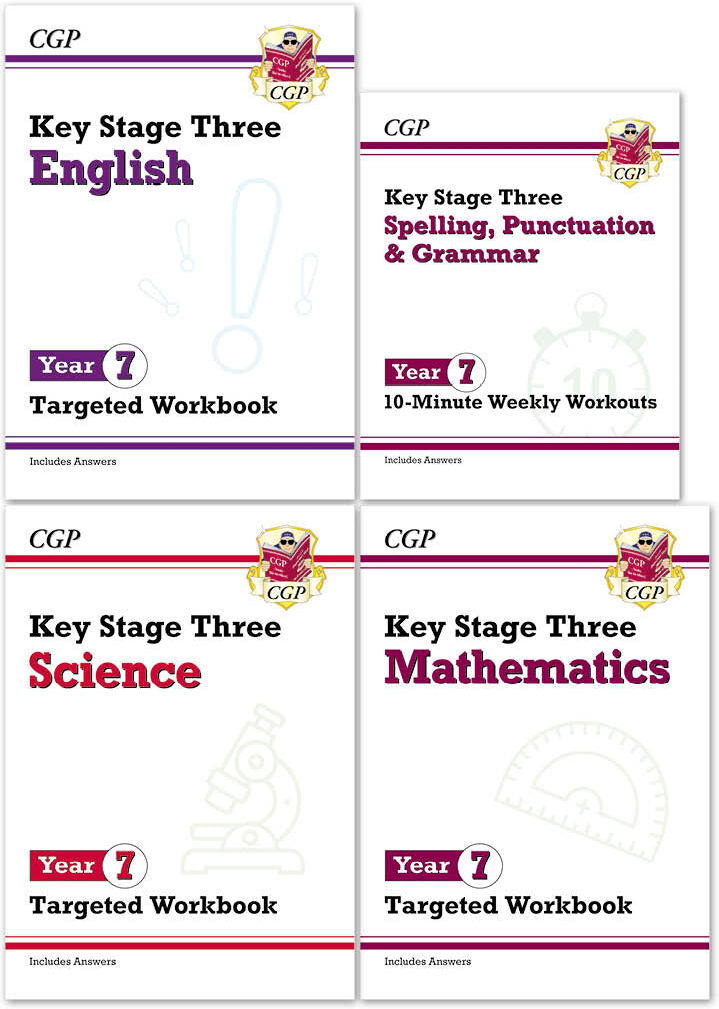
CGP Books CGP KS3 Year 7 Workbook Bundle – Ages 11-12 (Maths, English, Science, Spelling Punctuation and Grammar)You can't beat CGP books for KS3 practice! This brilliant bundle is exactly what Year 7 kids need to build their Maths, English and Science skills. It contains four books, full of essential practice — to be used in the classroom or at home! KS3 Year 7 Maths Targeted Workbook (9781789083163) KS3 Year 7 English Targeted Workbook (9781789087833) KS3 Year 7 Science Targeted Workbook (9781789082630) KS3 Year 7 Spelling, Punctuation and Grammar 10-Minute Weekly Workouts (9781837740550) KS3 Year 7 Maths Targeted Workbook For perfectly targeted Year 7 Maths practice, look no further. This KS3 Maths Yearly Targeted Workbook is loaded with practice questions - ideal for honing those essential Maths skills! It covers a range of topics and techniques from the KS3 syllabus, all set at the perfect difficulty for Year 7 pupils. For each topic, questions begin with a gentle warm-up, designed to get pupils up to speed and test what they already know, then progress to more difficult questions. KS3 Year 7 English Targeted Workbook For perfectly levelled Year 7 English practice, look no further! This KS3 English Yearly Targeted Workbook contains stacks of practice questions - ideal for honing those essential reading and writing skills, all matched to the National Curriculum. This brilliant workbook covers a huge variety of texts, from non-fiction to poetry, and helps students understand Shakespeare as well as develop vital essay writing skills. We’ve included prior knowledge checks for each topic, plus there’s extension activities enabling students to practise and integrate different skills that they’ve learned. Each topic is rounded off with a review section including test-style questions to bring everything together. KS3 Year 7 Science Targeted Workbook This beautifully crafted CGP Workbook features an array of Biology, Chemistry and Physics questions, all set at the perfect difficulty for students in Year 7. It's absolutely spot on for honing those all-important Science skills. The questions cover a range of techniques and topics, and aim to challenge common misunderstandings, prepare students for the mathsy and practical sections of the course, and help put what they've learned into context. Topics also include a selection of warm-up questions - to test what students already know about each topic. We've rounded the book off with a stack of mixed test-style questions to bring everything students have learned together in one place. KS3 Year 7 Spelling, Punctuation and Grammar 10-Minute Weekly Workouts This fantastic Weekly Workouts book is packed with targeted practice covering all the essential KS3 Spelling, Punctuation and Grammar skills - perfect for Year 7 students! Each workout consists of a selection of warm-up questions, followed by more challenging questions and problem-solving activities to really test students' SPaG knowledge. Plus, with one workout for every week of the school year, they're the perfect way to help students sharpen their skills and...27,99 £*Shipping: 2,99 £Secure redirect to the provider
-
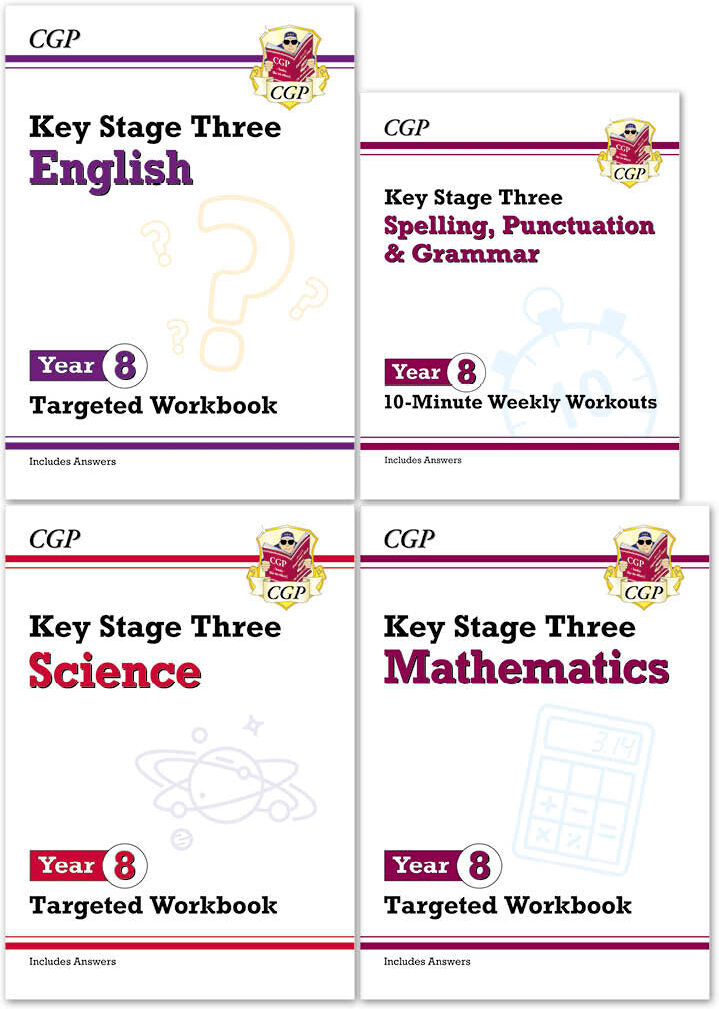
CGP Books CGP KS3 Year 8 Workbook Bundle – Ages 12-13 (Maths, English, Science, Spelling Punctuation and Grammar)You can't beat CGP books for KS3 practice! This brilliant bundle is exactly what Year 8 kids need to build their Maths, English and Science skills. It contains four books, full of essential practice — to be used in the classroom or at home! KS3 Year 8 Maths Targeted Workbook (9781789083170) KS3 Year 8 English Targeted Workbook (9781789087840) KS3 Year 8 Science Targeted Workbook (9781789082647) KS3 Year 8 Spelling, Punctuation and Grammar 10-Minute Weekly Workouts (9781837740567) KS3 Year 8 Maths Targeted Workbook If you're after Year 8 Maths practice, look no further. This KS3 Maths Yearly Targeted Workbook is loaded with practice questions - ideal for honing those essential Maths skills! It covers a range of topics and techniques from the KS3 syllabus, all set at the perfect difficulty for Year 8 pupils. For each topic, questions begin with a gentle warm-up, designed to get pupils up to speed and test what they already know, then progress to more difficult questions. KS3 Year 8 English Targeted Workbook For perfectly levelled Year 8 English practice, look no further! This KS3 English Yearly Targeted Workbook contains stacks of practice questions - ideal for honing those essential reading and writing skills, all matched to the National Curriculum. This brilliant workbook covers a huge variety of texts, from non-fiction to poetry, and helps students understand Shakespeare as well as develop vital essay writing skills. We’ve included prior knowledge checks for each topic, plus there’s extension activities enabling students to practise and integrate different skills that they’ve learned. Each topic is rounded off with a review section including test-style questions to bring everything together. KS3 Year 8 Science Targeted Workbook This spectacular CGP Workbook features an array of Biology, Chemistry and Physics questions, all set at the perfect difficulty for students in Year 8. It's absolutely spot on for honing those all-important Science skills. The questions cover a range of techniques and topics, and aim to challenge common misunderstandings, prepare students for the mathsy and practical sections of the course, and help put what they've learned into context. Topics also include a selection of warm-up questions - to test what students already know about each topic. KS3 Year 8 Spelling, Punctuation and Grammar 10-Minute Weekly Workouts This fantastic Weekly Workouts book is packed with targeted practice covering all the essential KS3 Spelling, Punctuation and Grammar skills - perfect for Year 8 students! Each workout consists of a selection of warm-up questions, followed by more challenging questions and problem-solving activities to really test students' SPaG knowledge. Plus, with one workout for every week of the school year, they're the perfect way to help students sharpen their skills and remember what they've learnt. All the answers are included at the back of the book, alongside a handy score sheet to keep track of students' progress -...27,99 £*Shipping: 2,99 £Secure redirect to the provider
-
Does my plant have fungi?
To determine if your plant has fungi, look for signs such as discolored or wilting leaves, moldy growth on the soil or plant, or a musty smell. You may also notice fuzzy white or black spots on the plant's leaves or stems. If you suspect fungi, it's best to remove the affected parts of the plant and improve air circulation to prevent further spread. Additionally, you can consult a plant expert or take a sample to a local nursery for identification and treatment recommendations. **
-
How do fungi feed themselves?
Fungi feed themselves by absorbing nutrients from their surroundings. They secrete enzymes that break down organic matter into simpler compounds, which they then absorb through their cell walls. Fungi can obtain nutrients from a variety of sources, including decaying organic material, living organisms, and even inorganic substances. This ability to break down and absorb nutrients from diverse sources is one of the reasons fungi are such successful and widespread organisms in nature. **
-
Why do fungi form fruiting bodies?
Fungi form fruiting bodies as a means of reproduction. These structures contain spores, which are dispersed into the environment to colonize new areas and start new fungal colonies. Fruiting bodies also help fungi to attract insects or animals that can aid in spore dispersal. Additionally, the formation of fruiting bodies allows fungi to conserve energy and resources until conditions are optimal for spore dispersal and germination. **
-
What is the metabolism of fungi?
The metabolism of fungi is primarily heterotrophic, meaning they obtain their energy and nutrients from organic sources. Fungi secrete enzymes to break down complex organic molecules into simpler compounds, which they can then absorb and use for energy and growth. Some fungi are also capable of mutualistic relationships with other organisms, such as mycorrhizal fungi that form symbiotic associations with plant roots to exchange nutrients. Overall, the metabolism of fungi is diverse and adaptable, allowing them to thrive in a wide range of environments. **
* All prices are inclusive of VAT and, if applicable, plus shipping costs. The offer information is based on the details provided by the respective shop and is updated through automated processes. Real-time updates do not occur, so deviations can occur in individual cases. ** Note: Parts of this content were created by AI.