Buy korrektur.eu ?
We are moving the project
korrektur.eu .
Are you interested in purchasing the domain
korrektur.eu ?
domain@kv-gmbh.de · 0541-91531010
Buy korrektur.eu ?
How can one convert acceleration to Earth acceleration?
To convert acceleration to Earth acceleration, one can use the formula: Earth acceleration = acceleration / 9.81 m/s^2. This formula is derived from the fact that Earth's gravitational acceleration is approximately 9.81 m/s^2. By dividing the given acceleration value by 9.81 m/s^2, one can determine how many times greater or smaller the acceleration is compared to Earth's gravitational acceleration. This conversion is useful for comparing accelerations in different contexts to the standard acceleration due to gravity on Earth. **
How can one convert acceleration to Earth's acceleration?
To convert acceleration to Earth's acceleration, one can simply divide the given acceleration by the acceleration due to gravity on Earth, which is approximately 9.81 m/s^2. This will give the acceleration in terms of how many times Earth's gravity it is. For example, if a car is accelerating at 5 m/s^2, dividing this by 9.81 m/s^2 will give approximately 0.51 g, where g represents Earth's acceleration due to gravity. **


Similar search terms for Acceleration
Top-Angebote
Products related to Acceleration:
-
METZGER 09001553 Sensor, longitudinal- / lateral accelerationFitting Position: lateral installation; Fitting Position: C-Pillar, Rear, Front, B-Pillar, Front and Rear; Sensor Type: Crash Sensor; Airbag: for side airbag; Production date from: 26.05.2014, 03.11.2014, 25.05.2015; Number of Doors: 4; for PR number: 4X1, 0A2; Production date to: 03.02.202060,99 £*Shipping: 8,45 £Secure redirect to the provider




-
What is the difference between gravitational acceleration and Earth's acceleration?
Gravitational acceleration is the acceleration experienced by an object due to the force of gravity, which is approximately 9.81 m/s^2 on the surface of the Earth. Earth's acceleration, on the other hand, refers to the acceleration of the Earth itself as it orbits the Sun, which is approximately 9.81 m/s^2 towards the Sun. In essence, gravitational acceleration is the acceleration experienced by objects on Earth due to gravity, while Earth's acceleration is the acceleration of the Earth as it moves through space. **
-
What is the difference between tangential acceleration and rotational acceleration?
Tangential acceleration is the acceleration of an object moving in a circular path, and it is directed along the tangent to the path. It is caused by a change in the object's speed or direction. On the other hand, rotational acceleration is the rate of change of angular velocity of an object rotating around an axis. It is caused by a torque or force acting on the object, and it is directed perpendicular to the plane of rotation. In summary, tangential acceleration is related to linear motion in a circular path, while rotational acceleration is related to the change in the rate of rotation of an object. **
-
What is the formula for acceleration in uniform acceleration in physics?
The formula for acceleration in uniform acceleration in physics is given by a = (v - u) / t, where a is the acceleration, v is the final velocity, u is the initial velocity, and t is the time taken. This formula represents the change in velocity over time, and it is used to calculate the rate at which an object's velocity is changing. Acceleration is measured in meters per second squared (m/s^2). **
-
Is acceleration always constant?
No, acceleration is not always constant. Acceleration is the rate of change of velocity, so if an object's velocity is changing at a constant rate, then its acceleration is constant. However, if an object's velocity is changing at a non-constant rate, then its acceleration will also be non-constant. For example, when an object is thrown upwards, its acceleration due to gravity is constant, but when a car is speeding up or slowing down, its acceleration is not constant. **

Why is there acceleration?
Acceleration occurs when there is a change in an object's velocity, either in magnitude or direction. This change can be caused by a force acting on the object, such as gravity, friction, or a push or pull from another object. According to Newton's second law of motion, the acceleration of an object is directly proportional to the net force acting on it and inversely proportional to its mass. Therefore, if there is a net force acting on an object, it will experience acceleration in the direction of the force. **
What is negative acceleration?
Negative acceleration, also known as deceleration or retardation, occurs when an object's velocity decreases over time. This means that the object is slowing down. Negative acceleration can be caused by forces such as friction, air resistance, or opposing forces acting on the object. It is represented by a negative value in equations of motion and is the opposite of positive acceleration, which causes an object to speed up. **
Top-Angebote
Products related to Acceleration:
-
METZGER 09001552 Sensor, longitudinal- / lateral accelerationFitting Position: lateral installation; Fitting Position: Front and Rear, C-Pillar, Rear, Front; Sensor Type: Crash Sensor; Airbag: for side airbag; for PR number: 4X1, 4X3, 0A2; Production date from: 31.05.2010; Production date to: 26.05.2014, 03.11.2014, 03.02.2020, 01.06.2020, 30.11.2015; Model Year to: 2014; Number of Doors: 4; Vehicle Identification Number (VIN) from: 2K-B-200 00160,99 £*Shipping: 8,45 £Secure redirect to the provider
-
METZGER 09001553 Sensor, longitudinal- / lateral accelerationFitting Position: lateral installation; Fitting Position: C-Pillar, Rear, Front, B-Pillar, Front and Rear; Sensor Type: Crash Sensor; Airbag: for side airbag; Production date from: 26.05.2014, 03.11.2014, 25.05.2015; Number of Doors: 4; for PR number: 4X1, 0A2; Production date to: 03.02.202060,99 £*Shipping: 8,45 £Secure redirect to the provider
-
How can one convert acceleration to Earth acceleration?
To convert acceleration to Earth acceleration, one can use the formula: Earth acceleration = acceleration / 9.81 m/s^2. This formula is derived from the fact that Earth's gravitational acceleration is approximately 9.81 m/s^2. By dividing the given acceleration value by 9.81 m/s^2, one can determine how many times greater or smaller the acceleration is compared to Earth's gravitational acceleration. This conversion is useful for comparing accelerations in different contexts to the standard acceleration due to gravity on Earth. **
-
How can one convert acceleration to Earth's acceleration?
To convert acceleration to Earth's acceleration, one can simply divide the given acceleration by the acceleration due to gravity on Earth, which is approximately 9.81 m/s^2. This will give the acceleration in terms of how many times Earth's gravity it is. For example, if a car is accelerating at 5 m/s^2, dividing this by 9.81 m/s^2 will give approximately 0.51 g, where g represents Earth's acceleration due to gravity. **
-
What is the difference between gravitational acceleration and Earth's acceleration?
Gravitational acceleration is the acceleration experienced by an object due to the force of gravity, which is approximately 9.81 m/s^2 on the surface of the Earth. Earth's acceleration, on the other hand, refers to the acceleration of the Earth itself as it orbits the Sun, which is approximately 9.81 m/s^2 towards the Sun. In essence, gravitational acceleration is the acceleration experienced by objects on Earth due to gravity, while Earth's acceleration is the acceleration of the Earth as it moves through space. **
-
What is the difference between tangential acceleration and rotational acceleration?
Tangential acceleration is the acceleration of an object moving in a circular path, and it is directed along the tangent to the path. It is caused by a change in the object's speed or direction. On the other hand, rotational acceleration is the rate of change of angular velocity of an object rotating around an axis. It is caused by a torque or force acting on the object, and it is directed perpendicular to the plane of rotation. In summary, tangential acceleration is related to linear motion in a circular path, while rotational acceleration is related to the change in the rate of rotation of an object. **
Similar search terms for Acceleration
-
DK Help Your Kids with English Ages 10–16 – KS3 & KS4 Grammar, Writing & Revision GuideIf English is sounding like a foreign language, make it easy and effortless with the ultimate study guide. This visual reference book takes you through all the different parts of the English language, leaving you ready to help your children tackle the trickiest of subjects. Carol Vorderman's unique study aid encourages parents and children to work together as a team to understand and use all aspects of the English language, including grammar, punctuation, and spelling.This latest title in the best-selling Help Your Kids series combines pictures, diagrams, instructions, and examples to cover the components of the school syllabus, while building knowledge, boosting confidence, and aiding understanding. With your support, children can overcome the challenges of English, leaving them calm, confident, and exam ready.9,99 £*Shipping: 2,99 £Secure redirect to the provider
-
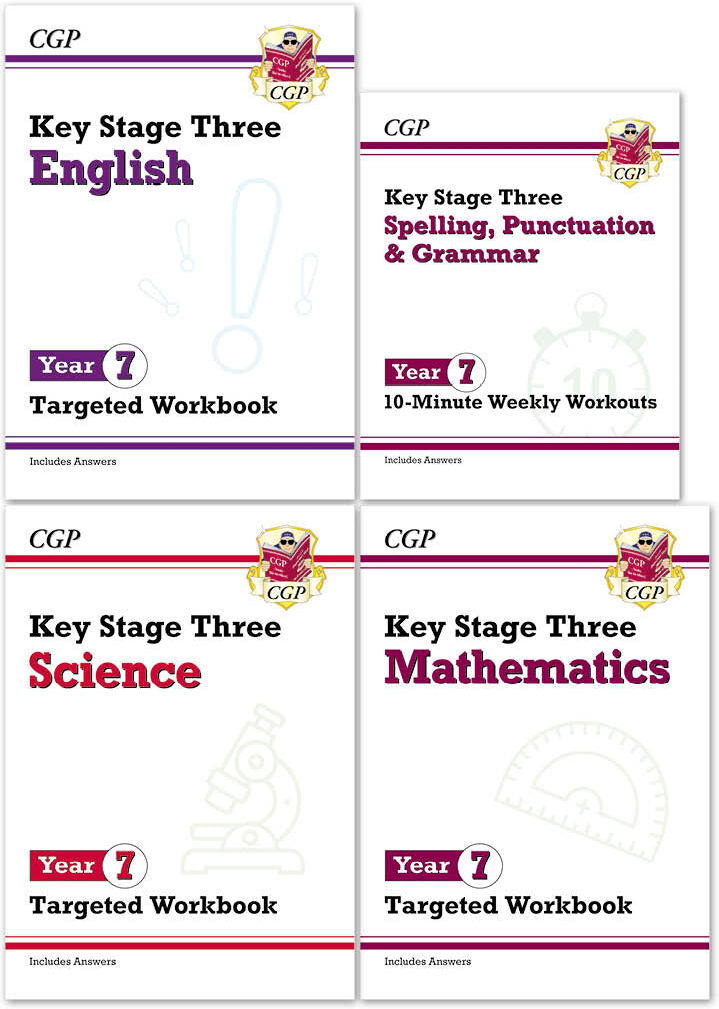
CGP Books CGP KS3 Year 7 Workbook Bundle – Ages 11-12 (Maths, English, Science, Spelling Punctuation and Grammar)You can't beat CGP books for KS3 practice! This brilliant bundle is exactly what Year 7 kids need to build their Maths, English and Science skills. It contains four books, full of essential practice — to be used in the classroom or at home! KS3 Year 7 Maths Targeted Workbook (9781789083163) KS3 Year 7 English Targeted Workbook (9781789087833) KS3 Year 7 Science Targeted Workbook (9781789082630) KS3 Year 7 Spelling, Punctuation and Grammar 10-Minute Weekly Workouts (9781837740550) KS3 Year 7 Maths Targeted Workbook For perfectly targeted Year 7 Maths practice, look no further. This KS3 Maths Yearly Targeted Workbook is loaded with practice questions - ideal for honing those essential Maths skills! It covers a range of topics and techniques from the KS3 syllabus, all set at the perfect difficulty for Year 7 pupils. For each topic, questions begin with a gentle warm-up, designed to get pupils up to speed and test what they already know, then progress to more difficult questions. KS3 Year 7 English Targeted Workbook For perfectly levelled Year 7 English practice, look no further! This KS3 English Yearly Targeted Workbook contains stacks of practice questions - ideal for honing those essential reading and writing skills, all matched to the National Curriculum. This brilliant workbook covers a huge variety of texts, from non-fiction to poetry, and helps students understand Shakespeare as well as develop vital essay writing skills. We’ve included prior knowledge checks for each topic, plus there’s extension activities enabling students to practise and integrate different skills that they’ve learned. Each topic is rounded off with a review section including test-style questions to bring everything together. KS3 Year 7 Science Targeted Workbook This beautifully crafted CGP Workbook features an array of Biology, Chemistry and Physics questions, all set at the perfect difficulty for students in Year 7. It's absolutely spot on for honing those all-important Science skills. The questions cover a range of techniques and topics, and aim to challenge common misunderstandings, prepare students for the mathsy and practical sections of the course, and help put what they've learned into context. Topics also include a selection of warm-up questions - to test what students already know about each topic. We've rounded the book off with a stack of mixed test-style questions to bring everything students have learned together in one place. KS3 Year 7 Spelling, Punctuation and Grammar 10-Minute Weekly Workouts This fantastic Weekly Workouts book is packed with targeted practice covering all the essential KS3 Spelling, Punctuation and Grammar skills - perfect for Year 7 students! Each workout consists of a selection of warm-up questions, followed by more challenging questions and problem-solving activities to really test students' SPaG knowledge. Plus, with one workout for every week of the school year, they're the perfect way to help students sharpen their skills and...27,99 £*Shipping: 2,99 £Secure redirect to the provider
-
What is the formula for acceleration in uniform acceleration in physics?
The formula for acceleration in uniform acceleration in physics is given by a = (v - u) / t, where a is the acceleration, v is the final velocity, u is the initial velocity, and t is the time taken. This formula represents the change in velocity over time, and it is used to calculate the rate at which an object's velocity is changing. Acceleration is measured in meters per second squared (m/s^2). **
-
Is acceleration always constant?
No, acceleration is not always constant. Acceleration is the rate of change of velocity, so if an object's velocity is changing at a constant rate, then its acceleration is constant. However, if an object's velocity is changing at a non-constant rate, then its acceleration will also be non-constant. For example, when an object is thrown upwards, its acceleration due to gravity is constant, but when a car is speeding up or slowing down, its acceleration is not constant. **
-
Why is there acceleration?
Acceleration occurs when there is a change in an object's velocity, either in magnitude or direction. This change can be caused by a force acting on the object, such as gravity, friction, or a push or pull from another object. According to Newton's second law of motion, the acceleration of an object is directly proportional to the net force acting on it and inversely proportional to its mass. Therefore, if there is a net force acting on an object, it will experience acceleration in the direction of the force. **
-
What is negative acceleration?
Negative acceleration, also known as deceleration or retardation, occurs when an object's velocity decreases over time. This means that the object is slowing down. Negative acceleration can be caused by forces such as friction, air resistance, or opposing forces acting on the object. It is represented by a negative value in equations of motion and is the opposite of positive acceleration, which causes an object to speed up. **
* All prices are inclusive of VAT and, if applicable, plus shipping costs. The offer information is based on the details provided by the respective shop and is updated through automated processes. Real-time updates do not occur, so deviations can occur in individual cases. ** Note: Parts of this content were created by AI.